Military Service · Major Life Chapter

Army Air Forces
Pilot Training Pipeline

Harold S. Hartman · 1943–1944

Before a pilot could fly for the Army Air Forces, the candidate had to be classified, schooled, conditioned, and tested. This exhibit follows three documented milestones through that demanding wartime system.

Scroll to explore ↓
Period1943–1944
Documented milestones3
LocationsAlabama · South Carolina
ConfidenceHigh, review required

The documented journey

Preparation, advancement, and flight training

In 1943 and 1944, the United States was producing military pilots on an extraordinary scale. Harold S. Hartman’s surviving records place the individual inside that system at three consequential points: pre-flight preparation, appointment as Sergeant, and completion of elementary flying training.

The records do not reveal every classroom, instructor, aircraft, or hour in the cockpit. Instead, the records provide something more disciplined: fixed documentary points from which a responsible historical chapter can be reconstructed.

“What the archive does not say is part of the story too.”

The visual archive

Places, aircraft, and records

Demonstration imagery illustrates how approved research, artifacts, maps, and media can be assembled into a visitor experience.

All four visuals in this prototype are AI-generated demonstration imagery. They are not original historical artifacts and must not be treated as personal evidence.

Three fixed points

Training timeline

Sep 1943
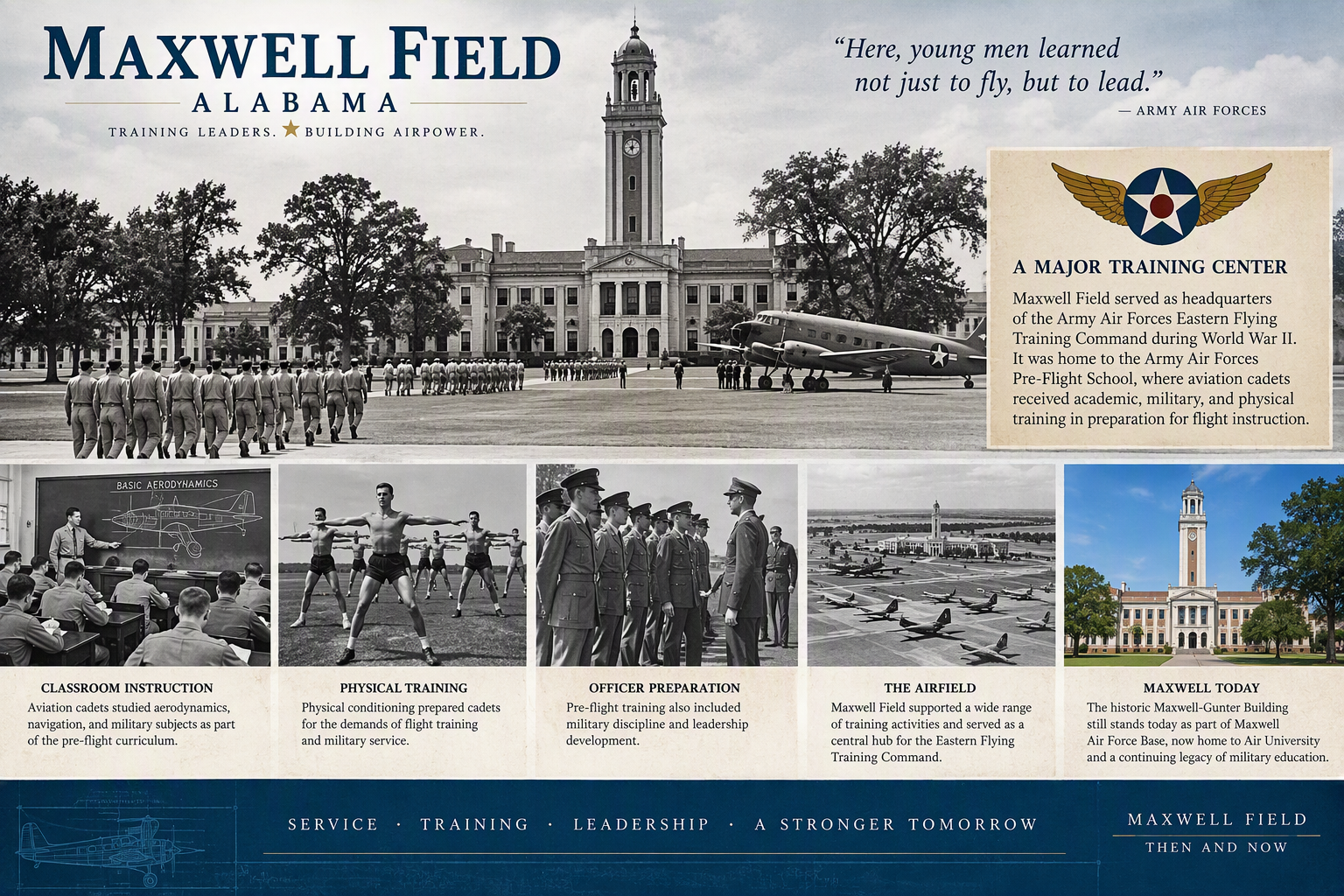
Maxwell Field demonstration visual

Documented event

Army Air Forces Pre-Flight School

Maxwell Field, Alabama

Approved records place Harold S. Hartman in pre-flight training, the academic, military, and physical preparation stage before flight instruction.

Evidence boundary

The record does not establish a class designation, instructors, course scores, or individual daily experiences.
6 Sep 1943
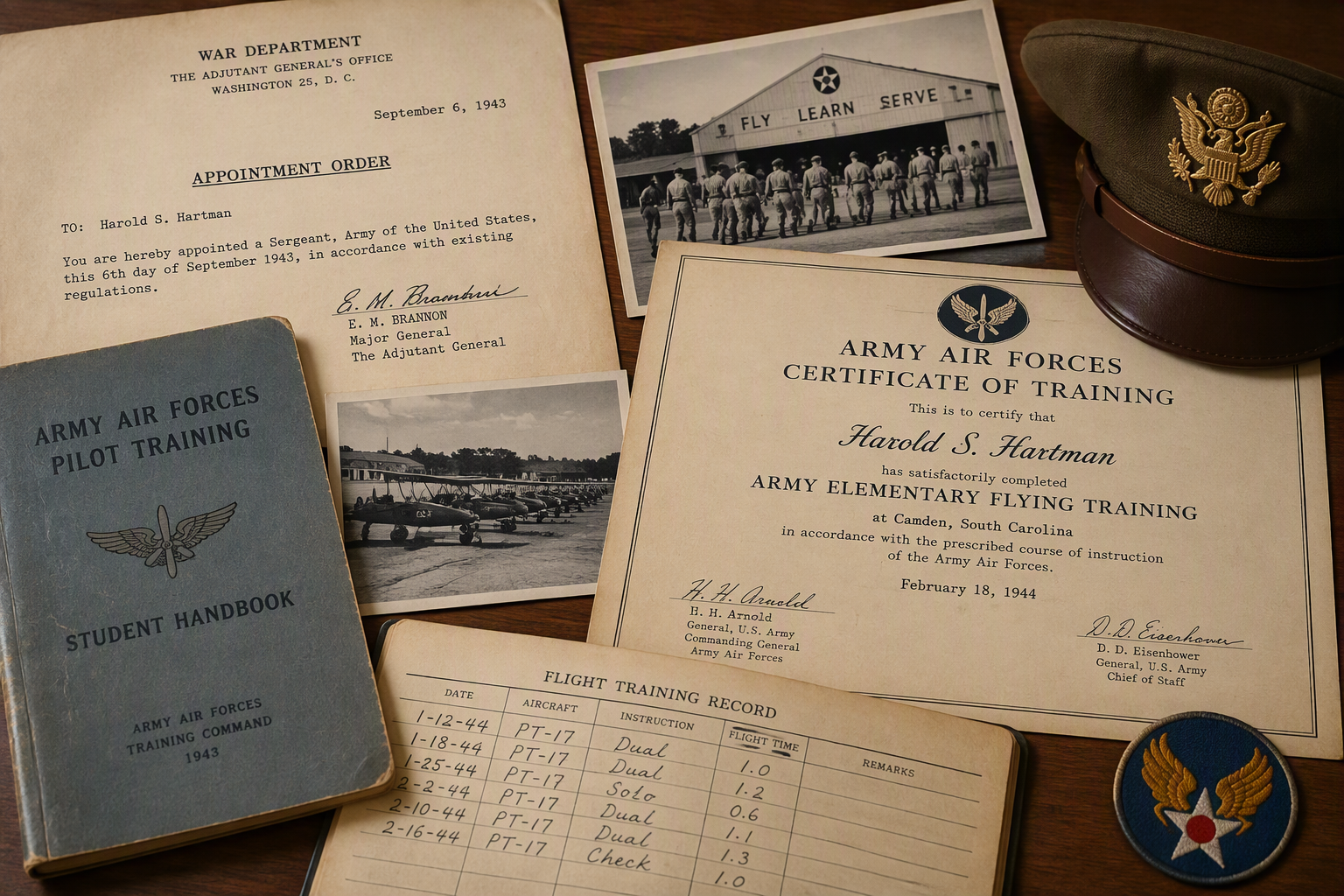
Demonstration visual of training documents

Documented event

Appointment as Sergeant

Maxwell Field, Alabama

A surviving record documents an appointment as Sergeant during the pre-flight period.

Evidence boundary

The available record does not explain the reason for the appointment or the responsibilities that accompanied it.

18 Feb 1944
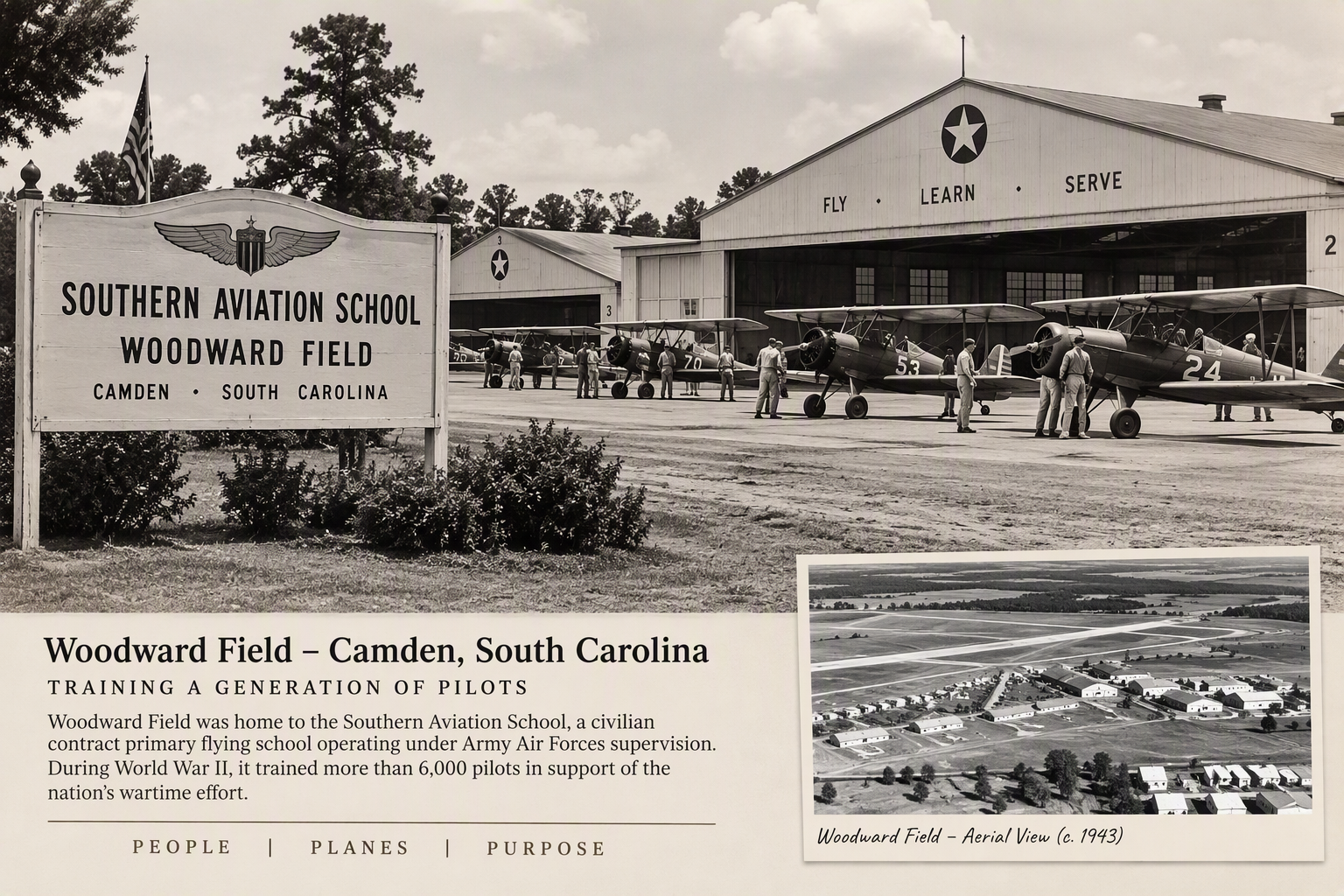
Camden training environment demonstration visual

Documented event

Completion of Army Elementary Flying Training

Camden, South Carolina

Approved evidence records completion of Army Elementary Flying Training, a milestone in the documented progression.

Evidence boundary

The record does not establish aircraft type, logged hours, instructor, class designation, or subsequent training stage.

Step inside the system

The world around the records

01

The training pipeline

Army Air Forces pilot training followed a sequence of Classification, Pre-Flight, Primary, Basic, Advanced, and Transition stages.

02

Pre-flight preparation

Pre-flight work combined academic study, military instruction, physical conditioning, recognition training, and preparation for flight instruction.

03

Wartime scale

The southeastern training system expanded rapidly before consolidating as wartime demand changed during 1944.

04

A visible boundary

Historical context explains the environment. Historical context does not independently prove an individual’s experience.

Geography of a chapter

Two documented locations

Documented location

Maxwell Field, Alabama

A major Army Air Forces training installation and headquarters environment. The Sergeant appointment is documented at Maxwell Field.

Documented location

Camden, South Carolina

The approved record identifies Camden as the location where Army Elementary Flying Training was completed.

Context-only connection: Woodward Field and Southern Aviation School explain Camden’s wartime aviation environment. The currently approved personal evidence does not independently name a particular school or facility.

Then and now

What remains

Then

Wartime training fields

Hangars, barracks, classrooms, drill fields, trainers, and administrative records supported a national pilot-training effort.

Now

Traces in archives and landscapes

Surviving structures, museum aircraft, class books, orders, certificates, and family collections make reconstruction possible.

Research in progress

The record is not complete

Open questions remain about class assignments, instructors, aircraft, flight hours, later training stages, and identity variants. Patriot Legacy Vault keeps those gaps visible.

  • Class designation and roster
  • Aircraft type and flight record
  • Instructor and check-ride records
  • Training after Camden
  • Resolution of name variants

Sources and method

Evidence before interpretation

Personal evidence

Approved Life Timeline events documenting pre-flight training, appointment as Sergeant, and completion of elementary flying training.

Contextual research

Air University, Army Air Forces historical studies, the National Museum of the United States Air Force, Camden repositories, historic-property records, and aviation authorities.

Human review

This prototype remains a controlled demonstration. Identity, citations, permissions, and public claims require human approval before publication.